
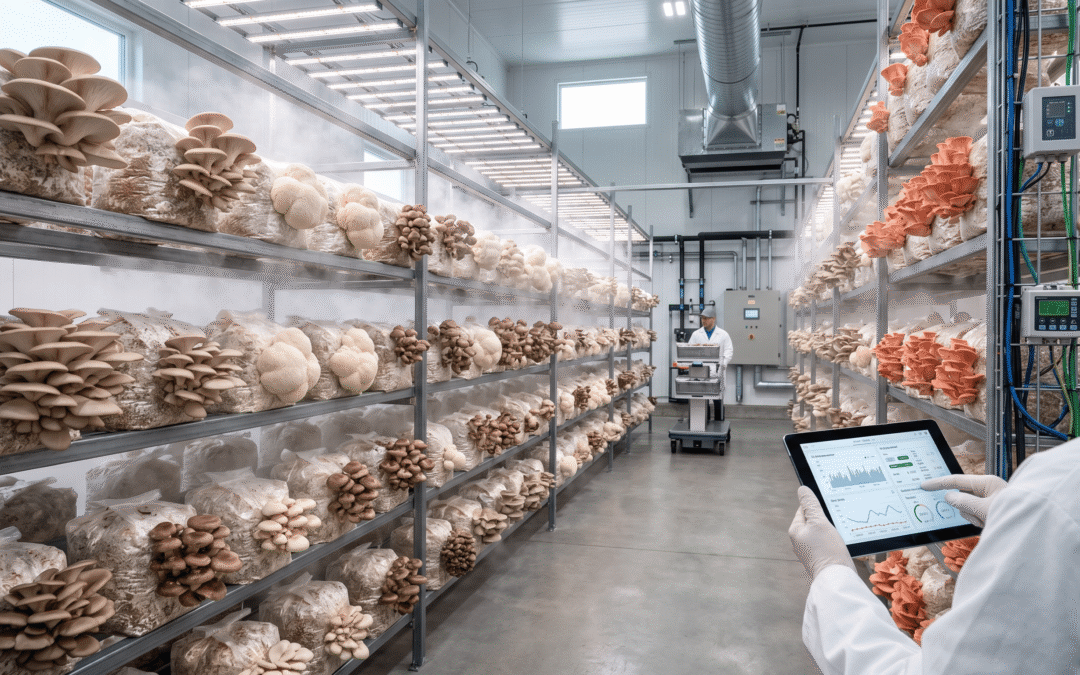
Traditional agriculture is fighting an uphill battle against unpredictable weather patterns, degrading soil health, and intense water scarcity. Yet, inside a highly specialized sector of Controlled Environment Agriculture (CEA), a quiet revolution is taking place.
The global mushroom market is scaling rapidly, projected to surpass $117 billion by 2030. Unlike traditional field crops, mushrooms don’t care about seasons, rainfall, or sunlight. They thrive vertically, footprint-for-footprint, using up to 85% less water per kilogram than traditional crops like lettuce or tomatoes.
But turning fungi into a highly predictable, factory-style asset class isn’t simple. It’s a game of extreme precision. If you are trying to scale a commercial mushroom facility today using legacy, hand-monitored systems, you are likely leaving massive margins on the table.
Let’s look at the three critical bottlenecks quietly draining profits from commercial indoor growers—and how intelligent automation transforms cultivation from an art form into a high-yield industrial process.
1. The 5% Microclimate Trap: Managing Humidity & CO₂ Shifts
Each distinct stage of mushroom growth requires a completely different environmental recipe. During the incubation (spawn run) stage, mycelium prefers higher temperatures and heavily elevated carbon dioxide ($CO_2$) levels to encourage vegetative growth. However, the moment you trigger the pinning and fruiting stages, the climate requirements change entirely.
The Problem: Hand-checked digital meters or fixed-timer ventilation loops create invisible pockets of stagnant air—microclimates. A sudden drop of just 5% in relative humidity can dry out young pinheads, causing them to abort before they ever turn into a flush. Conversely, over-watering or stagnant damp air invites aggressive competitor molds like Trichoderma (Green Mold).
The Automated Solution: Dynamic Sensor Arrays
Modern automated operations use decoupled, industrial-grade sensor grids placed at varying heights within the growing racks.
-
Integrated HVAC systems adjust fan speed, fresh air intake, and ultrasonic humidification nozzles based on real-time $CO_2$ and parts-per-million (ppm) feedback rather than a rigid schedule.
-
By keeping humidity locked at a precise $\pm 2\%$ window and executing smooth, automated step-downs in $CO_2$ levels, growers can achieve uniform pinning across the entire bed. This standardizes harvest timing and increases overall biological efficiency.
3. The Cold-Chain Race: Halting Post-Harvest Degradation
Mushrooms are fundamentally different from traditional vegetables. They lack a protective outer skin or cuticle, meaning they continue to breathe heavily and lose water at an accelerated rate immediately after being picked.
[Harvest] ──> [Ambient Exposure (Rapid Evaporation)] ──> [Spoilage/Weight Loss]
                                 │
                     (Automated Pre-Cooling Intervention)
                                 ▼
                     [Core Temperature Dropped to 2°C] ──> [Extended Shelf-Life]
[Harvest] ──> [Ambient Exposure (Rapid Evaporation)] ──> [Spoilage/Weight Loss]
│
(Automated Pre-Cooling Intervention)
▼
[Core Temperature Dropped to 2°C] ──> [Extended Shelf-Life]
The Problem: If harvested mushrooms sit at standard ambient room temperatures for even 3 to 4 hours before entering cold storage, they suffer from rapid respiration, brown discoloration, and severe weight loss. In the commercial space, weight loss equals direct profit loss.
The Automated Solution: Automated Flash Pre-Cooling
Leading-edge commercial operations route their harvesting directly into automated vacuum cooling or forced-air chillers.
-
Automated systems instantly pull down the core temperature of the mushroom to exactly $2^\circ\text{C}$ to $4^\circ\text{C}$ within minutes of harvest.
-
By locking this process into an automated workflow, you effectively halt the respiration cycle, preserve the bright color profiles that retailers demand, and extend the marketable shelf-life by up to 5 whole days.
3. Moving From Instinct to Industrial Scale
The growers setting production records today aren’t necessarily those with decades of manual experience—they are the ones leveraging data. By removing human variability from temperature, humidity, and airflow management, mushroom cultivation transitions from a high-stakes guessing game into a predictable, repeatable production line.
Scaling an indoor facility requires investing in the right digital infrastructure to monitor, react, and optimize every square meter of your grow space.
Ready to maximize your commercial yield? At mspawan, we build the digital frameworks, intelligence tracking strategies, and automated process guidelines that empower modern agri-businesses to scale seamlessly.