While the tech sector and venture capitalists spend billions of dollars attempting to engineer the perfect circular economy from scratch, a quiet, multi-billion-dollar industry has been running a flawless zero-waste loop for decades.
Welcome to the modern commercial mushroom industry.
Long relegated to the background of traditional farming, mushroom cultivation is stepping into the spotlight. Driven by a global shift toward functional nutrition, meat alternatives, and sustainable agriculture, the humble fungus is transforming from a basic culinary ingredient into a powerhouse of biotechnology and high-yield entrepreneurship.
Here is how the mushroom industry is completely flipping the traditional agricultural playbook on its head—and why it represents one of the most lucrative, resilient agribusiness models of our time.
1. Vertical Efficiency: Redefining the Agricultural Footprint
In traditional commercial agriculture, scaling your business requires a massive, capital-intensive investment: horizontal land. If you want to double your yield of wheat, corn, or vegetables, you generally need to double your acreage.
The mushroom industry operates on an entirely different axis.
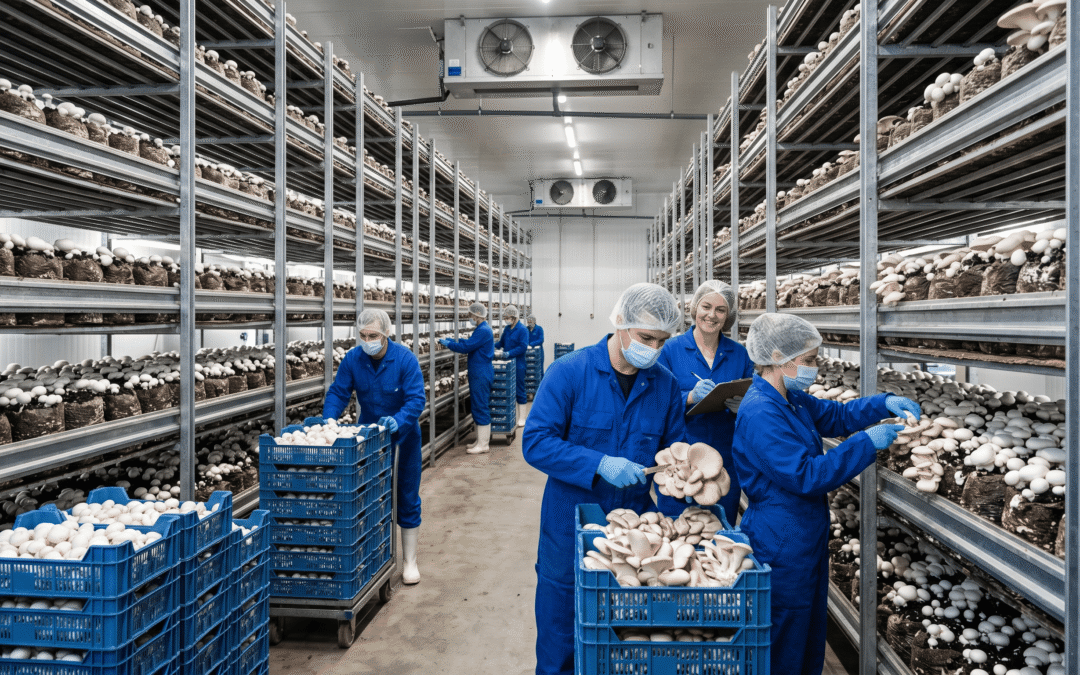
Because commercial mushrooms are grown indoors under strict, climate-controlled environmental conditions, farmers optimize vertical cubic feet rather than horizontal acres.
The Vertical Advantage:
-
Space Optimization: Multi-tier shelving systems allow growers to stack production layers up to the ceiling. A single cultivation room can produce a yield equivalent to multiple acres of traditional outdoor farmland.
-
Geographic Flexibility: Because it doesn’t rely on fertile topsoil, a modern mushroom facility can be set up almost anywhere—from rural agricultural hubs to urban warehouses right next to major consumer markets, drastically cutting down transport emissions.
-
Climate Independence: Growing indoors isolates the crop from unpredictable weather patterns, droughts, and seasonal shifts. It is a predictable, 365-day-a-year production engine.
2. The 40-Day Sprint: Rapid Capital Rotation
One of the steepest risks in traditional farming is the long cash-conversion cycle. Farmers invest heavily in seeds, fertilizer, and labor, only to wait several months—or even years—to see a return on investment. A single bad weather event right before harvest can wipe out an entire season’s capital.
Mushrooms operate at a tech-startup pace.
[Spawning / Inoculation] ---> [Mycelium Running] ---> [Pinning & Harvesting]
|<----------------------- 30 to 45 Days Total ----------------------->|
Popular commercial varieties like White Button (Agaricus bisporus) and Oyster mushrooms (Pleurotus ostreatus) move from initial spawning to final harvest in rapid 30 to 45-day cycles.
For agribusiness entrepreneurs, this tight turnaround offers an extraordinary financial advantage. Capital rotates rapidly. Cash flow is consistent, and production schedules can be dynamically adjusted to meet real-time market demands and price fluctuations.
3. The Ultimate Upcycle: Capitalizing on Bio-Waste
The most elegant feature of the mushroom industry is its input economics. While traditional crops require expensive synthetic fertilizers and heavy chemical inputs, mushrooms thrive on what the rest of the agricultural sector throws away.
Mushrooms are nature’s ultimate recyclers. The primary raw materials used to create mushroom substrate (the growing medium) include:
-
Wheat straw and paddy straw
-
Cottonseed hulls
-
Sawdust and wood chips
-
Sugar cane bagasse
In many agricultural regions, these low-value residues are treated as waste and are often burned in the fields, contributing heavily to air pollution. The mushroom industry rescues these materials, using the unique enzymatic power of fungi to break down tough lignocellulose and convert cheap byproducts into a premium, protein-dense, highly nutritious superfood.
4. Closing the Loop: Spent Mushroom Substrate (SMS)
A true circular economy produces zero waste. The mushroom industry achieves this in its final phase.
Once the harvesting cycles are complete, the leftover growing medium is known as Spent Mushroom Substrate (SMS). Instead of hitting a landfill, SMS is highly sought after by organic farmers and landscapers.
| Current Uses for Spent Substrate | Future Industrial Applications |
| High-grade organic bio-compost | Bio-remediation (breaking down soil toxins) |
| Soil conditioner for structural retention | Base material for renewable bio-plastics |
| Nutrient-rich potting soil blends | Potential feedstock for advanced bio-CNG/biofuels |
Every single component of the supply chain pays for itself or feeds back into the ecosystem.
The Road Ahead: Overcoming the Scaling Bottlenecks
While the macroeconomics of the industry are incredibly compelling, scaling a commercial mushroom enterprise isn’t without its challenges. Moving from a boutique farm to a high-output commercial facility requires solving two critical bottlenecks:
A. Automation and Precision Climate Control
Mushrooms are highly sensitive organisms. Minor fluctuations in ambient temperature, relative humidity, carbon dioxide levels, and fresh air exchanges can drastically impact yield quality and volume. The future of the industry lies in smart automation—integrating IoT sensors and automated HVAC controllers to maintain perfect growing conditions with minimal human error.
B. Cold-Chain Logistics
Because fresh mushrooms have a high moisture content and a relatively short shelf life, securing a robust local cold-chain logistics network is vital. Processing excess yields into dried mushroom powder, canned varieties, or functional health supplements is rapidly becoming a key strategy for smart producers to hedge against market volatility.
Final Thoughts: The Agribusiness of Tomorrow
The global mushroom market is no longer a niche agricultural sub-sector. It is a booming, multi-billion-dollar landscape standing at the intersection of culinary demand, biotechnology, and environmental sustainability.
By decoupling food production from massive land requirements and transforming agricultural waste into premium nutrition, the mushroom industry isn’t just surviving the challenges of modern agriculture—it is showing the rest of the world how to solve them.
Are you looking to integrate smart technology into your agricultural supply chain, or exploring the business of sustainable food systems? Let’s build the future of food together. Explore our latest guides or get in touch with our team today.