
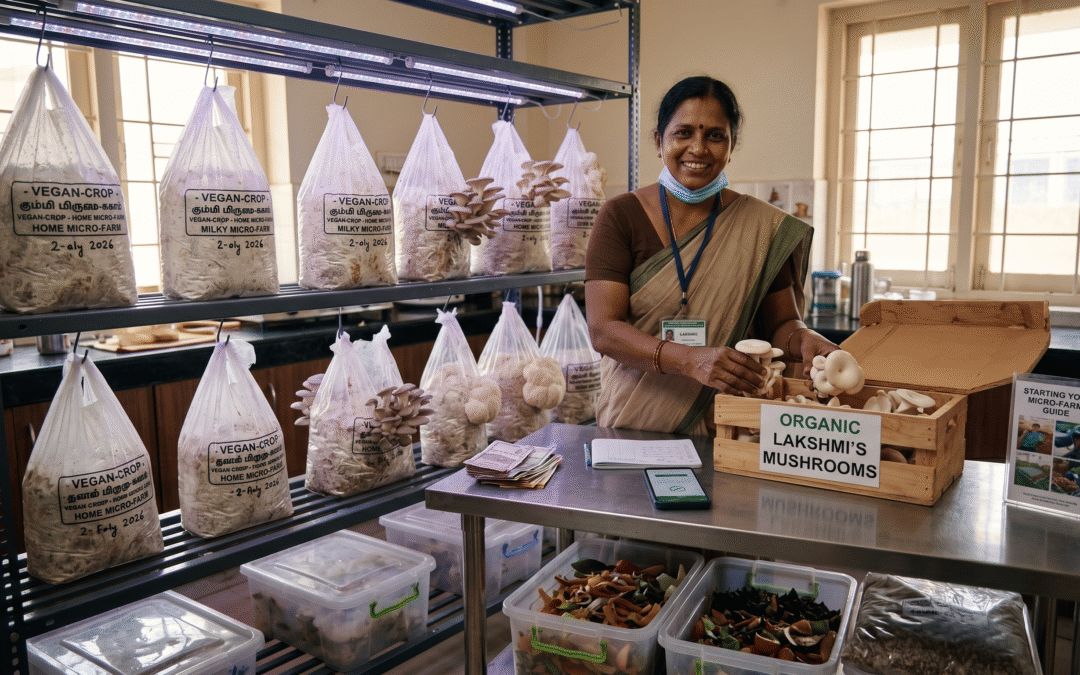
Imagine turning your unused balcony, a spare room corner, or even the space under your staircase into a source of income — without owning a single acre of land.
That is not a fantasy. Thousands of urban Indians are already doing it, growing gourmet mushrooms at home and selling them to local restaurants, vegetable vendors, and organic buyers — all with a startup investment under ₹5,000.
Here is everything you need to know to start your own mushroom micro-farm and turn kitchen-scale cultivation into a real side income.
Why Mushroom Farming is the Perfect Urban Side Hustle
Unlike most agribusiness ventures, mushroom cultivation requires no soil, no sunlight, and almost no space. It fits naturally into an urban lifestyle because it works indoors, on a schedule you control.
Here is what makes it uniquely suited for Indian homes in 2026:
- Zero Land Required: A 6×4 ft room or a covered balcony is enough to run 20–30 grow bags simultaneously.
- Fast Returns: Oyster mushrooms fruit in as little as 14–21 days from spawn inoculation — no waiting months for a harvest.
- Low Water Consumption: Mushrooms need humidity, not irrigation. A simple hand sprayer is enough.
- Year-Round Production: With basic temperature management, you can grow 12 months a year — unlike seasonal crops.
- High Market Demand: Gourmet varieties like Pink Oyster, Pearl Oyster, and Milky mushrooms command ₹200–₹600/kg in urban markets.
The Three Things You Actually Need to Start
Most people overcomplicate this. Here is the honest breakdown of what you need to begin:
1. Quality Spawn — The Most Critical Input
This is where most beginners go wrong. They buy cheap, unverified spawn from an unreliable source and wonder why their bags get contaminated or yield poorly.
Premium grain spawn, produced in a sterile laboratory environment, is the single biggest factor in your harvest success. It colonizes your substrate faster, crowds out contamination, and delivers dense, heavy flushes.
Pro Tip: Always source spawn from a certified lab supplier with consistent, documented yields. One bad batch can cost you an entire growing cycle.
2. Substrate — Your Growing Medium
Mushrooms grow on agricultural waste, not soil. The most accessible substrates for Indian urban growers are:
- Paddy straw — readily available across North India, works excellently for Oyster mushrooms
- Wheat straw — similar results, slightly denser flush
- Sawdust — ideal for Shiitake and specialty varieties
- Cotton waste / sugarcane bagasse — excellent for warm-weather cultivation
You can source all of these locally, often for free or at minimal cost.
3. Basic Climate Control
Mushrooms are sensitive to temperature and humidity — but managing both is simpler than it sounds:
- Temperature: Oyster mushrooms fruit at 18–30°C depending on variety. In Delhi NCR, summers require a cooler corner; winters are naturally ideal.
- Humidity: 80–90% RH. Achieved easily with 3–4 manual misting rounds per day, or a basic humidifier.
- Air Exchange: Fresh air (FAE) is crucial. A simple USB fan running a few hours a day is enough.
What a Small-Scale Setup Actually Earns
Let us talk numbers — because this is the part that matters most.
A basic home setup with 30 grow bags (using 1.5 kg substrate each):
- Expected yield per bag per flush: 300–500g of fresh mushrooms
- Total yield per flush: 9–15 kg
- Market price (Pink Oyster, local): ₹250–₹400/kg
- Revenue per flush: ₹2,250–₹6,000
- Flushes per bag: 2–3 over its productive life
With 2 flushes per batch and re-inoculation cycles running monthly, a serious micro-farmer can generate ₹8,000–₹20,000/month from a spare room — with costs of spawn and substrate well under ₹2,500/month.
Where to Sell Your Harvest
Growing is only half the equation. Here are the most accessible sales channels for urban Indian micro-farmers:
- Local restaurants and dhabas — especially those serving continental or multi-cuisine menus, always looking for fresh gourmet varieties
- Apartment WhatsApp groups — direct-to-consumer with zero middlemen and maximum margin
- Organic vegetable vendors and sabzi mandis — high footfall, consistent weekly offtake
- Online grocery platforms — list on Swiggy Instamart, Zepto, or Blinkit as a local supplier
- Catering businesses — single bulk orders can absorb an entire week’s harvest
Ready to Grow Your First Flush?
The biggest mistake is waiting until everything feels perfect before starting. The learning curve in mushroom cultivation is steep at first but flattens quickly — most growers produce their best flush by their third or fourth batch.
At Milkyway Mushroom (mspawn.in), we supply high-yielding, laboratory-grade grain spawn for Oyster, Milky, and specialty mushroom varieties — trusted by home growers and commercial cultivators across India.
Start with clean genetics. Everything else follows.
The Big Three: Best Gourmet Varieties for Beginners
If you’re ready to clear a small corner in your home or setup a small-scale cultivation space, these are the varieties trending right now:
1. Pink Oyster (Pleurotus djamor)
-
The Look: Striking, vibrant pink clusters that look like coral reef formations.
-
The Flavor: Subtly woody with a distinct aroma that many compare to bacon or seafood when fried crisp.
-
Why Grow It: It absolutely thrives in warmer tropical temperatures, making it incredibly resilient and fast-growing.
2. Blue/Pearl Oyster (Pleurotus ostreatus)
-
The Look: Gorgeous, dense caps ranging from deep slate blue to soft silver-grey.
-
The Flavor: Mild, sweet, and slightly nut-like. It’s the ultimate all-rounder for stir-fries and pastas.
-
Why Grow It: It loves cooler ambient temperatures and produces massive, heavy flushes.
3. Golden Oyster (Pleurotus citrinopileatus)
-
The Look: Brilliant, sun-yellow, delicate caps.
-
The Flavor: Intensely nutty and aromatic when cooked.
-
Why Grow It: It is a aggressive colonizer, meaning it tears through substrate quickly, leaving less room for contamination.
2. The Secret to a Massive Harvest: It’s All in the Spawn
When people fail at growing mushrooms, they usually blame the humidity or temperature. But more often than not, the culprit is weak or contaminated spawn.
Think of mushroom spawn as your seeds. If you start with generic, low-vitality genetics, your yields will be small, slow, and prone to contamination. High-quality, laboratory-grade grain spawn acts like a supercharged engine for your substrate (whether you are using straw, sawdust, or agricultural waste).
Cultivation Tip: Oyster mushrooms are incredibly aggressive. When introduced to premium grain spawn, the mycelium—the root-like network of the fungus—will rapidly take over the bag, giving you your first flush of gourmet mushrooms in as little as 14 to 21 days.
3. Ready to Start Your Flush?
Whether you’re looking to cultivate a few bags for your kitchen table or setting up a local commercial supply, the journey begins with clean, potent genetics.
At Milkyway Mushroom (mspawn.in), we supply premium, high-yielding mushroom spawn cultivated under strict laboratory conditions to ensure maximum bio-efficiency and contamination-free growth.