
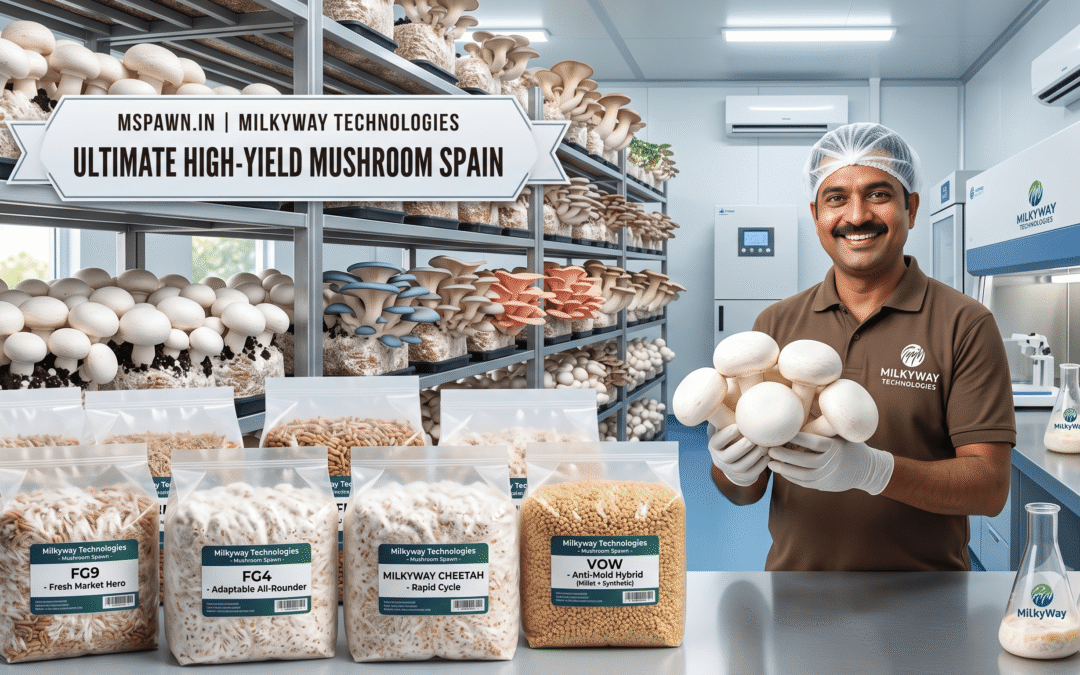
For a commercial mushroom grower in India, your choice of spawn isn’t just an initial input—it is the single most critical factor determining your profit margins. You can optimise your climate control systems, perfect your compost formulation, and maintain spotless hygiene, but if your genetics are weak, your yield will cap out long before you break even.
With temperature fluctuations across the country and the constant threat of mold contamination, Indian growers need resilient, high-performing genetics.
Let’s break down the science of choosing the right commercial spawn strains to maximize your harvest per square foot.
1. The Market Standard: Button Mushroom Strains (Agaricus bisporus)
Button mushrooms command the highest demand in fresh Indian markets, but they are notoriously sensitive to compost quality and environment. To secure a predictable harvest, you need strains engineered to handle reality, not just lab conditions.
-
The Fresh Market Hero (Strain FG9): This is currently the most favored spawn strain across India.
It produces large, beautifully smooth white mushrooms with a short stipe (stem), giving it an excellent weight-to-cap ratio. Its standout feature is its extended shelf life, making it the absolute best choice if you are transporting your harvest to fresh wholesale mandis. It tolerates minor temperature and $CO_2$ variations exceptionally well. -
The Adaptable All-Rounder (Strain FG4): If you are working with variable compost quality or regional temperature fluctuations, FG4 is a powerhouse.
It adapts aggressively to different compost types and produces dense, fleshy, medium-sized mushrooms ideal for handpicking.
2. The Innovation Leap: Milkyway Cheetah
When time-to-market is your primary KPI, you cannot afford to wait around for a sluggish spawn run.
Milkyway Cheetah is engineered with proprietary activating bioagents.
It is a super-fast strain designed to complete both the spawn run and case run in a fraction of the standard time.
By speeding up the vegetative cycle, you effectively shrink the window of vulnerability where competitor molds can establish themselves. The result? Robust, medium-to-large mushrooms with a perfect stipe-to-cap ratio, getting you to your first flush ahead of schedule.
3. Combating Green Mold with Advanced Substrates
Every grower dreads a breakout of Trichoderma (green mold), which can decimate an entire crop cycle overnight. Traditional grain spawn relies strictly on cereal grains like wheat or sorghum, which are highly nutritious but also highly attractive to molds if moisture levels fluctuate.
Traditional Grain Spawn (High Risk) ───► Vulnerable to Mold Breakouts
Milkyway VOW Substrate (Low Risk)     ───► Anti-Mold Synthetic + Millet Mix
To solve this, advanced formulations like VOW utilize an exclusive combination of a unique synthetic substrate mixed with the raw nutrition of millet.
4. Diversifying for High Margins: Exotic Varieties
While button mushrooms dominate in volume, exotic mushrooms offer significantly higher margins per kilogram.
| Mushroom Variety | Key Market Advantage | Ideal Substrate |
| King Oyster | Thick, meaty stems; exceptional shelf life for retail | Pasteurized straw, sawdust blocks |
| Shiitake | Exploding popularity in premium urban Indian markets | Sterilized hardwood sawdust |
| Colored Oyster | Striking visual appeal (Blue, Yellow, Pink, White) | Highly adaptable, rapid colonization |
The Bottom Line: Cultivating Excellence
Commercial mushroom farming is a game of efficiency. Investing in premium, laboratory-tested spawn strains with proven tracking systems reduces your risk of contamination, ensures uniform flushes, and keeps your production line running smoothly.
At Milkyway Technologies, we’ve been pioneering international-quality spawn production in India since 1997.