
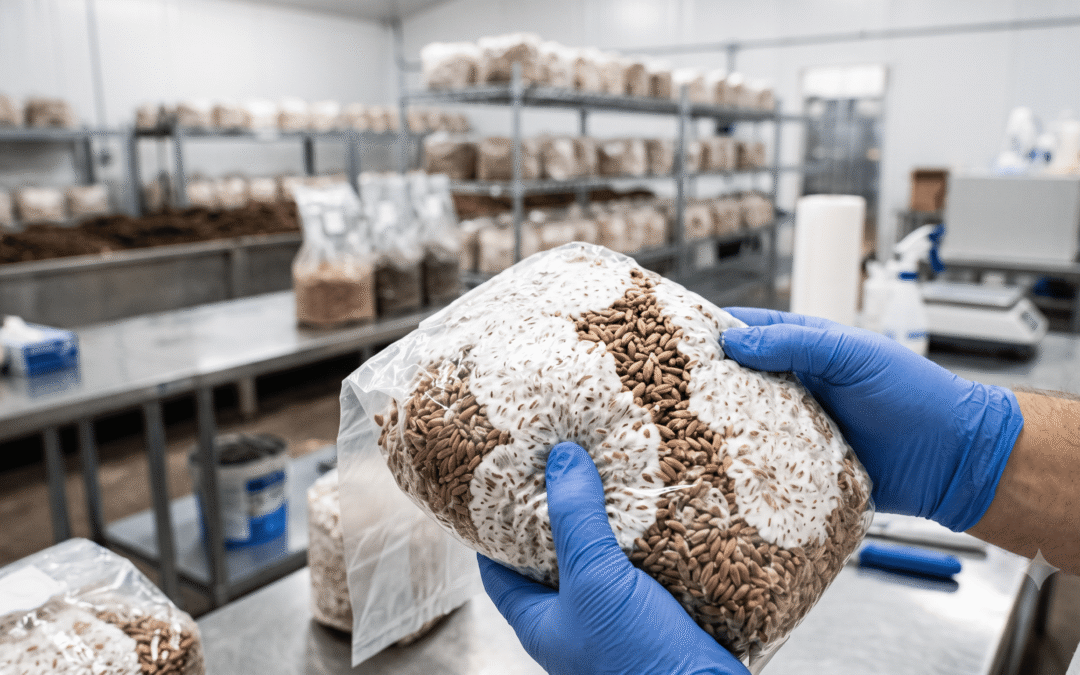
In commercial mushroom farming, growers spend months fine-tuning compost formulations, climate control units, and humidity levels. Yet, even with state-of-the-art infrastructure, yields often fall short of benchmarks.
The root cause almost always traces back to the very starting point: the spawn.
Mushroom spawn is not simply seeded grain. It is a living, breathing fungal culture carrying specific genetic vigor, enzymatic capability, and contamination resistance. Understanding how commercial-grade spawn drives biological efficiency can save your setup from stunted flushes and sudden crop failures.
The Science Behind Spawn Vigour
When you inoculate substrate or compost, you are triggering a race against opportunistic competitors like Trichoderma green mould, cobweb, and bacterial blotch.
High-performing spawn wins this race through three non-negotiable parameters:
-
High Colony Forming Units and Rapid Mycelial Run: Strong, pure cultures colonize grain uniformly without forming thick, non-viable stroma. Quick colonization starves competing spores of oxygen and moisture.
-
First-Generation Culture Integrity: Multi-transferred mycelium suffers from senescence—a decline in vigor caused by repeated sub-culturing. Reliable commercial laboratories use mother cultures refreshed directly from verified pure strains to maintain aggressive vegetative growth.
-
Substrate Moisture Balance: Grain cooked too wet splits, creating an anaerobic pocket where wet bubble or bacterial slime thrives. Grains cooked too dry leave the mycelium starved of early hydration. Commercial-grade grain preparation balances internal kernel moisture at 48% to 50% without surface wetness.
Common Red Flags in Commercial Mushroom Spawn
Before mixing a new batch of spawn into your bags or compost beds, check for these warning signs:
| Defect | Visible Indicator | Underlying Risk |
| Sectoring | Patches of differing mycelial texture or thickness | Genetic instability or hidden contamination |
| Exudate Pooling | Brownish or yellow liquid droplets at the bottom | Heat stress, bacterial competition, or over-aging |
| Dense Mycelial Overlay | Rubbery, thick white crust instead of fluffy strands | Stroma formation; will not spread effectively into compost |
| Grain Clumping | Grains fused into dense, unshakeable rocks | High moisture or bacterial presence inside the bag |
Best Practices for Handling and Spawning
- Even top-tier spawn can degrade if mishandled between delivery and inoculation. Follow these operational guidelines to protect your investment:Acclimatization Before Mixing: If spawn arrives from cold storage at 2°C to 4°C, allow the bags to sit in a clean room at 18°C to 20°C for 4 to 6 hours before mixing. Inoculating freezing spawn directly into warm substrate induces thermal shock.
- Sterile Handling During Grain Breakage: Gently massage the bags to separate the grains into free-flowing particles before opening the bag. Never crush the grain, as split grains release free starch, which invites mould.
- Optimized Inoculation Rate: For button mushroom compost, maintain an inoculation rate of 0.5% to 0.7% of total compost weight. For oyster or specialty varieties on pasteurized straw or sawdust, use 2% to 3% based on wet substrate weight to ensure lightning-fast colonization.
Consistent Yields Start With Lab-Tested Inputs
Commercial mushroom cultivation operates on thin margins where a single infected batch wipes out weeks of energy and labor costs. Securing lab-grade, genetically stable spawn gives your setup the foundation it needs for heavy first and second flushes.
Explore our pure, lab-propagated strains designed for commercial growers at mspawn.in.