8585955966 [email protected]

Mushroom farming is no longer just about producing fresh edible mushrooms. Across India, growers are increasingly thinking about efficiency, sustainability, and how to get more value from every input they use in the cultivation cycle.sageuniversity+1

One of the biggest opportunities in modern mushroom farming lies not in the crop itself, but in what remains after harvest. Spent mushroom substrate, often treated as a disposal problem, can actually become a useful resource when managed correctly.ijcmas+1

For small and commercial growers alike, this shift in thinking opens up a bigger conversation: can mushroom waste support composting, soil enrichment, or even biogas systems? In many cases, the answer is yes — and that is exactly why circular mushroom farming is becoming such an important topic.

What is spent mushroom substrate?

Spent mushroom substrate, often called SMS, is the leftover growing material after a mushroom crop has completed its production cycle. Depending on the type of mushroom being cultivated, this substrate may include straw, agri-waste, sawdust, supplements, and mycelium-rich organic matter.ijcmas+1

Even though it is called “spent,” the material is not useless. It still contains organic matter and can often be repurposed in agriculture, compost systems, and in some cases as a feedstock component for biogas generation.ufz+2

For many farms, the real issue is not whether SMS has value, but whether they have a system to use it well. Without a plan, disposal becomes a cost. With a plan, it can become part of a smarter farm model biogas

Why this matters for mushroom growers

Mushroom farming already depends on good process management, clean inputs, and efficient use of space and materials. When growers begin looking beyond harvesting and selling, they often discover that post-harvest waste handling is one of the most overlooked profit and efficiency areas.

A farm that can reduce waste, improve reuse, and lower disposal pressure is usually in a stronger long-term position than one that treats every crop cycle as isolated. That matters even more in a market where mushroom cultivation in India continues to grow and competition is becoming more professional.

This is where circular thinking becomes powerful. Instead of asking, “How do I throw this away?” the better question is, “How many more uses can I get from this material?”

Can spent mushroom substrate be used for biogas?

Yes, spent mushroom substrate has been studied and used as a useful input in biogas-related systems, especially when combined with other organic materials such as manure or agricultural waste. Some studies and field examples show that SMS can support biogas generation as part of a mixed-feedstock approach rather than as a standalone miracle input.partner.projectboard+2

That distinction is important. Most growers should not assume that every batch of spent substrate can directly go into a biogas unit without technical evaluation, because feedstock quality, moisture, contamination, and mix ratios all affect performance.ijcmas+1

Still, the broader idea is highly practical: mushroom farms generate organic residue, and biogas systems are designed to convert suitable organic residue into energy and slurry. When done correctly, this creates a more circular operation with less waste and more value recovery.

How the circular model works

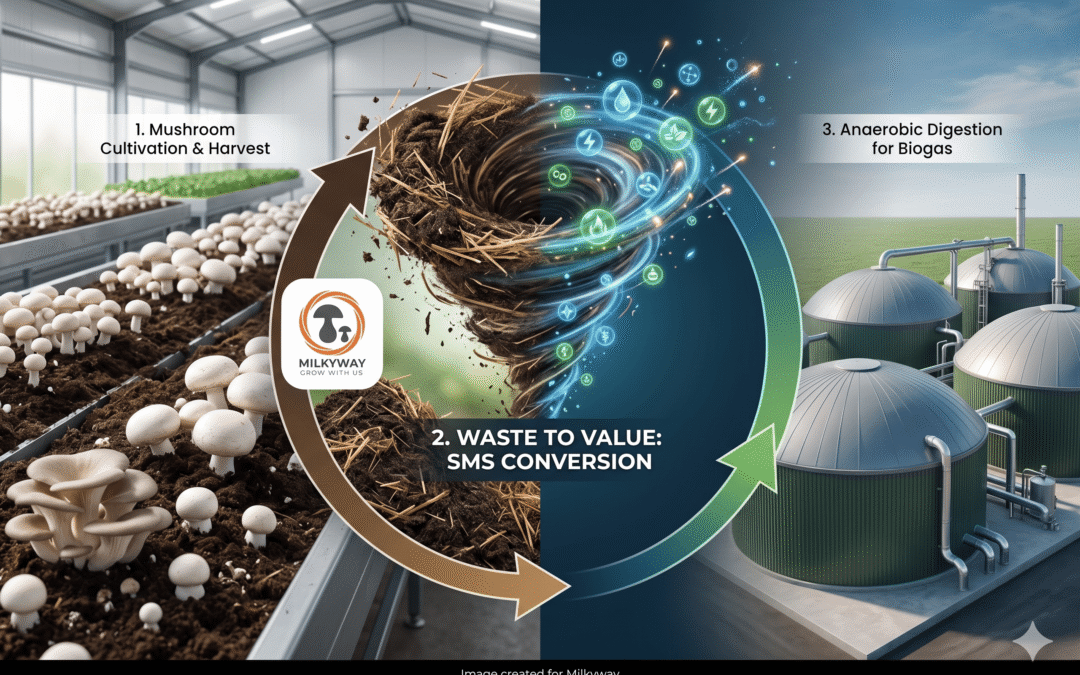
A simple version of the circular model looks like this:

  • Mushroom substrate is prepared and used for cultivation.

  • Mushrooms are harvested and sold.

  • The leftover substrate is collected instead of dumped randomly.

  • The material is evaluated for reuse, composting, or biogas input depending on farm scale and condition.biogas.

  • The resulting outputs, such as composted material or digested slurry, can support soil and nutrient management in agriculture.

This kind of system is attractive because it does not rely on a single revenue point. It creates operational value through resource efficiency, and that is often where better farm businesses separate themselves from average ones.

Benefits for growers

There are several reasons this topic matters for both new and established mushroom farmers:

  • Better waste management, because SMS does not have to remain only a disposal burden.

  • More sustainable branding, which helps farms position themselves as modern and environmentally responsible.

  • Potential integration with composting or biogas systems, especially in clustered rural or semi-commercial setups.

  • Improved resource thinking, where each crop cycle creates downstream value instead of only leftover waste.

For farms that want to scale, this mindset matters. Buyers, partners, and even institutional ecosystems increasingly pay attention to how agri-businesses manage waste and efficiency, not just output volume.

Is biogas practical for every mushroom farm?

Not always. A small home grower or a micro-farm may not immediately need its own biogas setup, and trying to force one can be inefficient. In many cases, composting or localized agricultural reuse may be more practical than direct biogas integration.

However, for larger farms, farm clusters, or growers working alongside dairy, poultry, or mixed organic waste systems, biogas becomes much more realistic. Government-backed biogas support frameworks in India also show that plants are being encouraged across different capacity ranges, from small units to larger systems.

So the real takeaway is not that every mushroom farm should install a biogas plant tomorrow. It is that every serious mushroom farm should at least understand where its spent substrate can go and which reuse model makes the most sense.

What growers should do first

If you are a mushroom grower exploring this idea, start with process clarity instead of equipment purchase.

1. Track your substrate output

Measure how much spent substrate your farm produces in one crop cycle. Without volume data, it is impossible to judge whether composting, resale, external tie-ups, or biogas linkage makes economic sense.

2. Separate clean and contaminated waste

Only well-managed organic residue has reuse potential. If spent substrate is mixed carelessly with plastic, chemicals, or general waste, its value drops immediately.

3. Explore local integration

Talk to nearby farmers, compost operators, gaushalas, or biogas-linked agricultural units. In many cases, value comes from partnerships, not from building everything in-house.

4. Think beyond disposal

The goal should not be “remove waste cheaply.” The goal should be “design a farm system where leftovers still have purpose.” That is the smarter business lens.

Why this topic is important in India now

India’s mushroom sector continues to expand, with sources pointing to ongoing market and production growth. As the industry becomes more structured, topics like substrate efficiency, waste reuse, and circular farming will only become more relevant.

At the same time, India’s national bioenergy framework continues to support biogas deployment across multiple plant sizes and applications. That does not automatically make biogas suitable for every mushroom farm, but it does make the conversation more timely and commercially relevant than before.

This is why forward-looking mushroom businesses should not think only in terms of spawn, harvest, and sale. They should also think in terms of input efficiency, residue value, and long-term operational resilience.

Final thoughts

The future of mushroom farming is not just higher yield. It is smarter systems. Farms that learn how to extract value from every stage of cultivation will be better placed to grow sustainably and competitively.

Spent mushroom substrate should not automatically be seen as waste. In the right setup, it can become part of a broader circular model that supports composting, energy systems, and better farm economics.

At Milkyway Mushroom, we believe better farming starts with better inputs and better thinking. Clean spawn, strong cultivation practices, and smarter farm systems all work together to build a stronger mushroom business.