
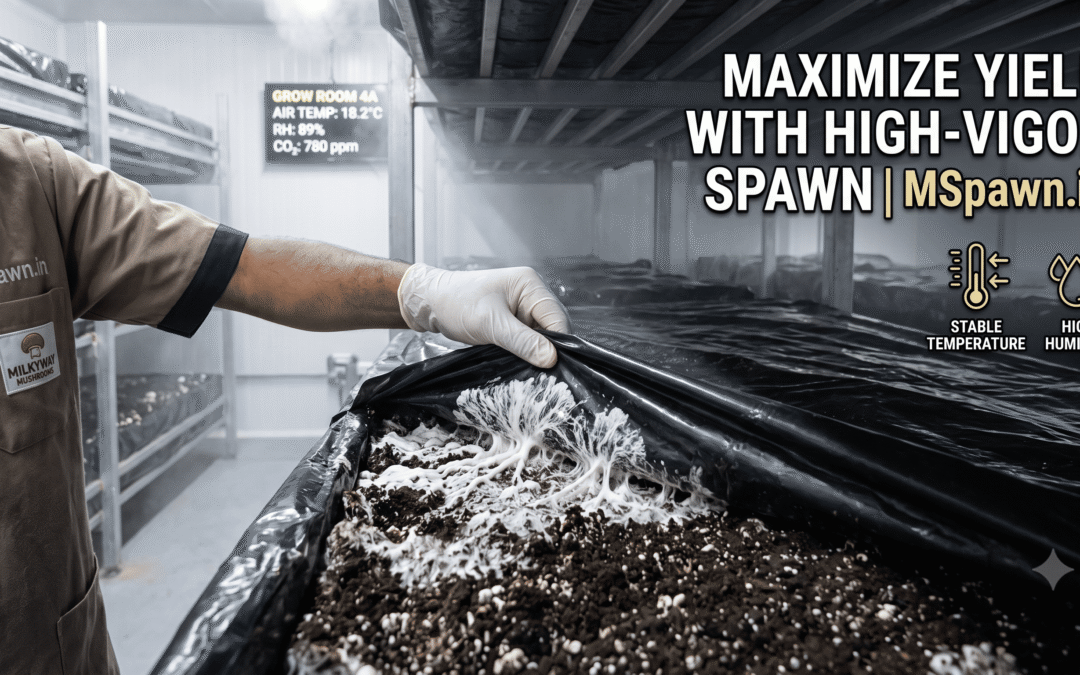
For commercial mushroom growers across India, achieving consistent flushes and high yield efficiency comes down to two critical factors: the vigor of your spawn and strict temperature management. Whether you are cultivating Button (Agaricus bisporus), Oyster (Pleurotus species), or heat-tolerant Milky Mushrooms (Calocybe indica), subtle shifts in substrate health or environment can make or break a crop cycle.
In this guide, we dive into the science of spawn vigor, how to prevent common growth issues like pinhead abortion, and environmental management strategies for year-round production.
What is Spawn Vigor (and Why Does It Matter)?
Spawn vigor refers to the metabolic strength, speed, and resilience of the mycelium during substrate colonization. High-vigor grain spawn doesn’t just run fast—it actively outcompetes opportunistic molds like Trichoderma (green mold) and Aspergillus.
Signs of High-Vigor Spawn:
-
Dense, Brilliant White Strands: Mycelium should look ropey (rhizomorphic) and robust, not faint or wispy.
-
Rapid Recovery Time: When shaken or broken up for spawning, healthy mycelium bounces back and begins re-colonizing fresh substrate within 24 to 36 hours.
-
Clean Aroma: Fresh spawn should smell earthy and sweet. Any sour, alcoholic, or musty odor indicates bacterial or fungal contamination.
Key Takeaway: Using low-vigor or aged spawn increases colonization times, giving competitive molds a head start that reduces total flush count.
Preventing Pinhead Abortion in Hot and Humid Climates
Pinhead abortion—where young primordia form but turn brown, wither, and stop growing—is one of the most frustrating challenges for commercial growers. It occurs primarily when environmental parameters fluctuate abruptly during the transition from pinning to fruiting.
       [ Primordia Formation ]
                  │
     ┌────────────┴────────────┐
     ▼                         ▼
[ Stable Conditions ]     [ Environmental Stress ]
  • High RH (85-90%)        • CO2 > 1000 ppm
  • Fresh Air Exchange      • Temperature Spikes
  • Gentle Moisture         • Dry Air / Water Droplets
     │                         │
     ▼                         ▼
[ Healthy Flush ]        [ Pinhead Abortion ]
Top Causes and Corrective Actions:
-
High Carbon Dioxide ($CO_2$) Levels
-
Problem: Accumulation of $CO_2$ during pinning causes spindly stems and aborted caps.
-
Fix: Increase fresh air exchange (FAE) once primordia appear, while maintaining relative humidity between 85% and 90%.
-
-
Direct Heavy Spraying
-
Problem: Blasting young pinheads with coarse water droplets suffocates delicate tissue, causing necrosis.
-
Fix: Use fine fogging nozzles or misters aimed upward so moisture settles gently over the growing area.
-
-
Temperature Spikes
-
Problem: Uncontrolled temperature swings inside the grow room stress the mycelium, causing it to abort secondary pins to preserve energy.
-
Fix: Match crop selection to seasonal temperature trends (e.g., transition to Milky Mushroom spawn during peak summer months when room temperatures exceed 30°C).
-
Species vs. Ideal Growth Parameters
Selecting the right strain for your regional climate reduces energy costs for climate control.
| Mushroom Variety | Ideal Colonization Temp | Fruiting Temp | Relative Humidity (RH) |
| Button (A. bisporus) | 23°C – 25°C | 14°C – 18°C | 85% – 90% |
| Oyster (Pleurotus spp.) | 24°C – 28°C | 18°C – 25°C | 80% – 90% |
| Milky (Calocybe indica) | 28°C – 32°C | 30°C – 35°C | 80% – 85% |
Best Practices for Spawn Handling & Storage
To preserve spawn quality from delivery to inoculation:
-
Inoculate Fresh: Use grain spawn as soon as possible after full colonization.
-
Cold Storage: If storage is required, keep Button and Oyster spawn at 2°C – 4°C. Note: Avoid chilling Milky Mushroom spawn below 15°C, as cold sensitivity can stall mycelial growth.
-
Sterile Spawning: Always sanitize tools, bags, and workspace surfaces with 70% isopropyl alcohol or bleach solution before mixing spawn into pasteurized substrate.