
When running a commercial mushroom facility, your substrate isn’t just “soil”—it’s a complex biochemical fuel tank. The ultimate metric of success in a growing room is Biological Efficiency (BE): how many kilograms of fresh mushrooms you harvest per 100 kg of dry compost.
If your flushes taper off rapidly after the first break, the root cause is rarely the spawn or the casing. It almost always traces back to a vital nutrient imbalanced during Phase I and Phase II composting: Nitrogen.
Let’s dive into the chemistry of balancing your Carbon-to-Nitrogen (C:N) ratio to unlock maximum flush longevity.
1. The Golden Ratio: Carbon vs. Nitrogen
Mushroom mycelium requires carbon for energy and nitrogen for synthesizing cellular proteins, enzymes, and the chitin that gives the caps their firm, market-ready texture. However, adding raw nitrogen sources blindly backfires quickly. Too much nitrogen releases excess free ammonia, which is completely toxic to mushroom spawn.
To get the perfect chemical foundation, aim for these exact parameters at specific stages of production:
| Composting Stage | Target Nitrogen % (Dry Weight) | Ideal C:N Ratio Range |
| Initial Mix (Day 0) | 1.5% to 1.7% | 30:1 |
| End of Phase I | 1.8% to 2.0% | 20:1 |
| Filling / Post-Phase II | 2.2% to 2.4% | 16:1 to 17:1 |
If your nitrogen drops below 2.0% at filling, the compost will exhaust its nutritional reserves early, leading to an underperforming third flush.
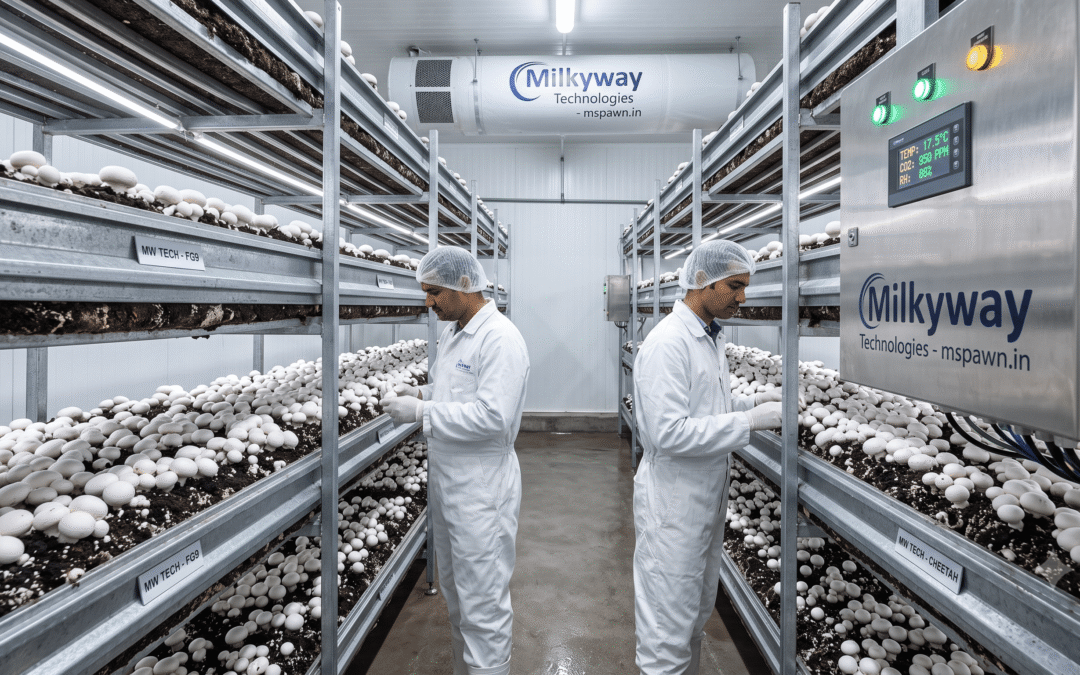
As seen in the high-yield room above, achieving a completely packed, uniform flush requires the mycelium to draw heavily on structural nitrogen reserves embedded deeply within the substrate layer.
2. Choosing High-Yield Nitrogen Supplements
Relying purely on agricultural inputs like wheat straw or paddy straw will leave your nitrogen percentages hovering around 0.5% to 0.7%. To bridge the gap to 2.2%, incorporate a calculated mix of organic and inorganic supplements:
-
Poultry Manure: Excellent, cost-effective source of organic nitrogen (~3% to 4% N). It fuels the thermophilic (heat-loving) microbial activity required to break down complex lignin in Phase I.
-
De-Oiled Cakes (Mustard or Cottonseed Cake): Superb slow-release nitrogen boosters (~5% to 6% N). They feed the mycelium progressively during the actual spawn run rather than flashing off early.
-
Urea / Ammonium Sulfate: Pure chemical nitrogen sources. They must only be added during the initial pre-wetting phase to kickstart fermentation. Never add chemical nitrogen late in Phase I, or it will fail to convert, leaving free ammonia behind.
3. The Phase II Conditioning Check: Banishing Ammonia
High nitrogen is useless if it doesn’t get properly “fixed” into microbial proteins. During Phase II pasteurization and conditioning, specific thermophilic fungi (like Scytalidium thermophilum) consume the free ammonia and turn it into digestible cellular biomass for your mushroom spawn.
The Zero-Ammonia Rule: Before spawning, your nose is your best diagnostic tool. The compost must have a sweet, clean, earthy forest scent. If you smell even a faint hint of sharp, stinging ammonia (above 5–10 ppm), do not spawn.
Inoculating compost that still contains free ammonia will chemically burn the delicate mycelial tips of your spawn, resulting in patchy, sluggish colonization and opening the door for competitor molds.
4. Modern Substrate Supplements: Pros & Cons
Many growers look to add delayed-release nutrients at the time of spawning or casing to push their biological efficiency past 100%. While highly effective, keep these operational boundaries in mind:
-
Formaldehyde-Treated Soy Protein: These commercial supplements are coated to prevent generic molds from accessing the nutrients early. The mushroom mycelial enzymes slowly break down the coating, releasing nitrogen directly to the crop during the pinning phase.
-
The Temperature Risk: Late supplementation increases the metabolic rate of the compost. If your indoor AC unit cannot handle the extra heat generated by a highly active substrate, bed temperatures can spike past 30°C, killing your mycelium. Ensure your HVAC systems have adequate cooling capacity before supplementing heavily.
Power Your Compost with Aggressive Genetics
Maximizing the nutritional value of your compost is only half the battle. You need a robust engine capable of efficiently converting those complex proteins into premium, solid mushroom tissue.
Looking to optimize your facility’s output?
Connect with the commercial technical consultants at Milkyway Technologies (mspawn.in). Secure high-vigor, certified Generation-1 commercial strains engineered for aggressive nutrient absorption and maximized biological efficiency.