
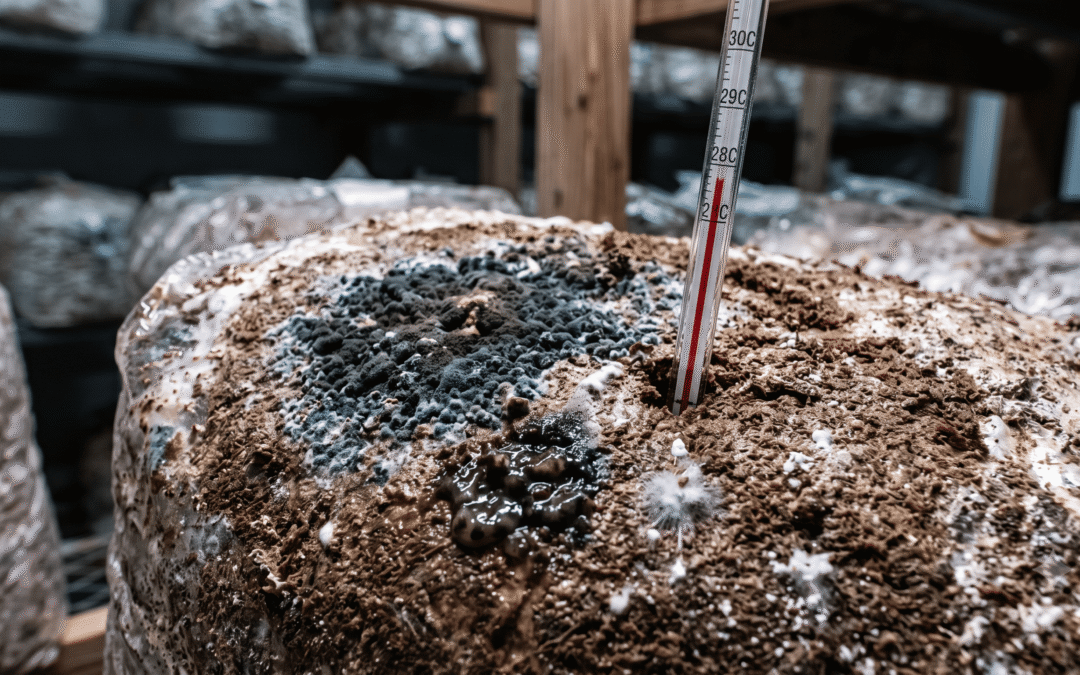
You’ve meticulously prepared your compost, sourced premium spawn, and dialed in your growing room’s climate controls. Yet, a week into the spawn run, the expected blanket of brilliant white mycelium is patchy, weak, or—worst of all—interrupted by patches of green or black mold.
What went wrong? Commercial mushroom cultivation is a game of microscopic margins. When a spawn run underperforms, growers often blame the weather or the room’s ambient temperature. However, the true culprit usually traces back to subtle, overlooked factors inside the substrate itself.
If you want to protect your investment and secure heavy, uniform flushes, you need to watch out for these three hidden causes of spawn run failure.
1. The Residual Moisture Trap (Anaerobic Pockets)
While mycelium requires moisture to thrive and transfer nutrients, there is a fine line between a hydrated substrate and a waterlogged one.
When compost moisture tips past 67% to 68%, gravity causes excess water to settle at the bottom of your bags, blocks, or shelves. This creates anaerobic (oxygen-deprived) zones.
-
The Problem: Mushroom mycelium is strictly aerobic; it must breathe. In oxygen-starved, waterlogged pockets, the mycelium suffocates and dies back.
-
The Threat: These anaerobic conditions roll out the red carpet for bacterial wet spot (sour rot) and competing molds that thrive without oxygen.
-
The Fix: Implement strict squeeze-tests during composting and ensure your substrate is uniformly mixed. If you use a denser synthetic blend or millet-based spawn combo, keeping moisture tightly capped at 63% to 65% is your safest bet for aggressive, uninhibited colonization.
2. Metabolic Heat Spikes (Core vs. Ambient Temperature)
One of the most common mistakes in commercial setups is relying solely on the room’s wall-mounted ambient thermometer.
Mycelial growth isn’t passive—it is a highly active biological process that generates its own metabolic heat. During the peak of the spawn run (usually days 5 to 9), the internal core of your compost bags or trays can easily be 3°C to 5°C hotter than the surrounding air.
[ Room Air: 24°C ] ---> [ Compost Surface: 25°C ] ---> [ Core Core/Center: 29°C 🔥 ]
-
The Problem: If your room’s ambient temperature is set to a standard 24°C, the core of your beds might secretly be spiking past 28°C or 29°C.
-
The Threat: High heat permanently damages or kills sensitive mycelium (like high-yielding Button strains), completely halting the run and leaving the compost defenseless against heat-tolerant green molds (Trichoderma).
-
The Fix: Never manage a room based on air temperature alone. Insert probe thermometers deep into the core of your center blocks. If the core starts climbing toward 27°C, proactively drop your room’s ambient air temperature to compensate and pull that internal heat away.
3. Genetic Drift and “Generation Degeneration”
Sometimes, your moisture is perfect and your temperatures are locked in, but the spawn simply grows at a snail’s pace. The mycelium looks fluffy, faint, and weak instead of aggressive, thick, and rhizomorphic (strandy). This is often the result of generation degeneration.
Mushroom cultures cannot be multiplied indefinitely. Every time a culture is transferred from an agar plate to a master grain, and then multiplied to a commercial grain layer, it ages.
-
The Problem: If a lab multiplies spawn across too many generations away from the original mother culture to save on costs, the strain suffers from genetic drift. It loses its biological vigor.
-
The Threat: Slow-moving spawn stretches your spawn run from 12 days to 20+ days. In commercial farming, an extended spawn run exponentially increases your climate-control power bills and gives competing fungi a massive window to overtake your crop.
-
The Fix: Always source your spawn from a laboratory that enforces strict multi-generation caps and rigorous quality control. High-performance strains—like the Milkyway Cheetah or VOW Medium lines—are specifically engineered and lab-verified to be close to the mother culture, ensuring they hit the compost with explosive, dominant growth.
💡 Pro-Tip for Commercial Growers
Always log the inoculation date and batch number of your spawn. Fresh, premium lab-tested spawn should ideally be introduced to your compost within 30 days of manufacturing for peak biological energy.
The Bottom Line
A flawless spawn run is the foundation of your entire financial yield. By ensuring precise moisture control, monitoring core metabolic heat rather than just air temperature, and utilizing high-vigor, low-generation spawn, you eliminate the variables that cause crops to fail.
Are you looking to upgrade your next cycle with ultra-aggressive, mold-resistant strains built for Indian growing conditions? Explore our scientifically backed spawn selection at